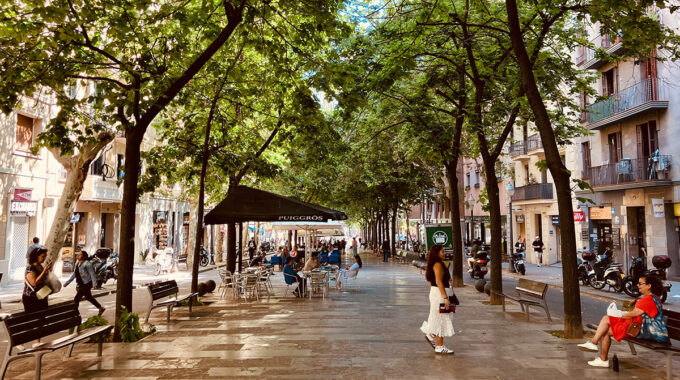
Barcelona is a city of neighbourhoods with very different personalities. Within just a few kilometres,…

What really determines the price of a flat in Barcelona?
Discussions about flat prices in Barcelona often turn to an average figure per square metre. On its own, however, that figure explains only part of the picture.
Two homes in the same neighbourhood, with similar floor areas and only a few streets apart, can have very different values. Exact location, condition, floor level, natural light, a lift, layout and the building’s features can all considerably change the final price.
Valuing a home correctly therefore requires analysing several factors and understanding how they interact.
1. Location: much more than the neighbourhood
Location is one of the strongest influences on a home’s value, but referring only to the district or neighbourhood can be too general.
Streets within the same area can differ considerably. Proximity to public transport, green spaces, schools, shops, services, shopping streets or particularly sought-after places can directly affect the price.
Noise, traffic, street width, the quality of public space and distance from major roads also matter.
Barcelona’s property market shows significant differences between districts. Figures published by property portals indicate that prices per square metre can vary considerably between areas such as Sarrià-Sant Gervasi, Eixample, Gràcia, Horta-Guinardó and Nou Barris.
2. Floor area and layout
Square metres are an essential reference, but not every square metre has the same value.
A well-designed home with little space wasted in corridors and a good balance between living and sleeping areas can be much more attractive than another of the same size with a less practical layout.
It is also important to distinguish between built area and usable floor area, as they are different measurements and can create mistaken impressions of the home’s actual size.
The number of bedrooms, the size of the dining room, kitchen and bathrooms, and the potential to rearrange rooms can also influence the valuation.
3. The floor on which the home is located
A flat’s floor level can have a considerable effect on its value.
Higher floors generally tend to have more natural light, better views and less street noise, particularly in densely built-up urban areas.
However, this factor is closely linked to having a lift. A high-floor flat in a building without one can be less appealing to a significant proportion of buyers.
Ground-floor and mezzanine homes may have less light or privacy, although some have terraces, patios or other features that compensate for this.
4. Aspect and natural light
Natural light is one of the most valued features in a home.
Aspect, height, street width, distance from the buildings opposite and whether the flat faces the street or an interior courtyard can determine how much daylight it receives.
In a densely built-up city such as Barcelona, this difference can be particularly important.
A bright home with good natural ventilation can be perceived as considerably more valuable than a similar but darker property.
5. Condition and renovations
The flat’s interior condition is another fundamental element.
A fully renovated home may justify a higher price than one requiring complete refurbishment. However, not all renovations add the same value.
Buyers often particularly value the quality of materials, electrical and plumbing installations, windows and doors, heating and cooling, the kitchen and bathrooms.
Some older homes also retain highly valued original features, such as patterned cement floor tiles, high ceilings, mouldings, joinery and other characteristics of Barcelona’s classic buildings.
6. The building’s condition
A flat’s value does not depend solely on its interior. Its building is also a deciding factor.
The condition of the façade, roof, courtyards, staircase and communal installations, as well as the presence of a lift, can affect perceptions and the home’s value.
It is also important to check for planned communal works, approved special assessments or outstanding refurbishment work.
In older buildings, good maintenance can make a significant difference compared with otherwise similar properties.
7. A lift, terrace, balcony and other distinctive features
Certain features can considerably increase a home’s appeal.
A lift, balcony, terrace, parking, storage room, communal areas or concierge service can influence price, particularly where such features are less common.
Following the experience of recent years, outdoor spaces have also become more important to many buyers.
Their value nevertheless depends on size, aspect, privacy and practical usefulness.
8. Energy efficiency
A home’s energy performance is an increasingly relevant factor.
Good windows and doors, efficient heating and cooling, thermal insulation and a good energy rating can reduce consumption and improve comfort.
These features do not always have a direct, proportional effect on price, but they can influence buyers’ decisions, especially when comparing similar properties.
9. Supply and demand at the time
A home’s price is also influenced by market conditions when it is sold.
The number of available properties, existing demand, interest rates, access to finance and the general economic situation can change buyer behaviour.
A valuation made several years ago may therefore no longer reflect current value.
In Barcelona, asking prices have varied significantly by period and district, reinforcing the importance of recent data when valuing a property.
10. The asking price is not always the sale price
A common mistake is to value a home simply by comparing listings on property portals.
Those listings show what owners are asking, but not necessarily the final prices at which sales complete.
Some properties may have been listed for months because their asking price exceeds what the market is willing to pay.
A professional valuation should therefore combine analysis of competing properties with comparable transaction information, the home’s specific features and current market conditions.
Why is multiplying floor area by an average price not enough?
An average price per square metre can provide an initial guide, but is unlikely to produce a precise valuation.
A street-facing sixth-floor flat with a lift, natural light and a terrace does not necessarily have the same value per square metre as an inward-facing first-floor flat without a lift, even on the same street.
That is precisely why property valuation methods consider many variables, including location, floor area, condition, floor level, a lift, construction year, energy efficiency and other features of the building and home.
A good valuation is the first step towards a successful sale
Setting the right initial asking price is one of the most important decisions when putting a home on the market.
A price that is too high can reduce initial interest and lengthen the marketing period. A price that is too low can prevent the owner from realising the property’s full potential value.
The aim is to find a price consistent with the market and the home’s actual features.
Want to know what your flat in Barcelona is worth?
Every home is different, and its value depends on far more than floor area or neighbourhood.
At On Urbe, we analyse the property’s features, location, market conditions and comparable homes to establish a realistic valuation.
If you are considering selling your flat in Barcelona, knowing its true value is the best starting point for defining a good sales strategy.
Related Posts